







.
A South African health technology company, Nexus AI, is deploying artificial intelligence to help address one of Africa’s persistent healthcare challenges: the severe shortage and uneven distribution of radiologists capable of interpreting medical images.
The company’s AI-powered chest X-ray screening technology can analyse an image in less than 45 seconds, identifying abnormalities and patterns that may suggest pulmonary tuberculosis (TB). The system is designed to support not replace radiologists and other qualified healthcare professionals, making it particularly relevant to rural and underserved communities where specialist care can be difficult to access.
Bridging Africa’s Radiology Gap
Diagnostic imaging capacity has expanded across Sub-Saharan Africa, but specialist interpretation has not kept pace.
International guidance cited in the report recommends roughly 100–120 radiologists per million people, while many countries in Sub-Saharan Africa have fewer than one radiologist for every 300,000 to 500,000 people.
Nigeria illustrates the scale of the problem. With a population exceeding 230 million and fewer than 700 consultant radiologists, access to an X-ray does not necessarily translate into timely specialist interpretation. Radiologists and imaging facilities are also concentrated disproportionately in major cities.
Nexus AI is targeting this gap by providing a rapid first layer of image analysis that can help healthcare workers identify cases requiring further attention.
From Mobile Clinics to Medical AI
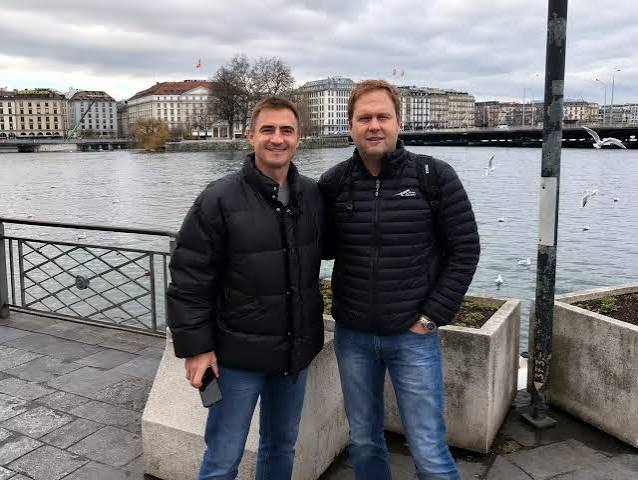
The company’s roots go back to 2013, when co-founders Dr Gerhard Ferreira and Andries Vorster began developing primary healthcare services across Africa.
Ferreira, a medical doctor and former owner of a large South African hospital group, teamed up with Vorster, an electronic engineer with expertise in clinical and medical engineering.
Their work eventually took them into mobile healthcare programmes, including X-ray screening initiatives in Mozambique. There, they encountered another challenge: screening large populations generated significant amounts of patient information that was difficult to manage using manual, spreadsheet-based systems.
The founders responded by developing Healthcare Framework, a clinical management platform that has since been used across about 20 African countries and processed more than five million consultations.
Nexus AI emerged from that work in 2021, focusing specifically on the bottleneck between taking an X-ray and getting it interpreted.
Designed for Clinics Without Reliable Power or Internet
A major feature of Nexus AI is its ability to operate in environments where conventional digital infrastructure is unreliable.
The system can run on edge devices such as laptops without an internet connection, allowing healthcare teams to analyse X-rays locally rather than depending entirely on cloud connectivity. It can also be deployed alongside portable, battery-powered X-ray equipment.
The company has demonstrated the technology in difficult environments, including rural locations in Lesotho and a deployment approximately four kilometres underground at a South African mine.
That infrastructure-independent approach is particularly relevant to rural healthcare systems, where unreliable electricity, connectivity and transportation can all delay diagnosis.
Google Partnership Accelerates Development
Nexus AI’s development was strengthened by a partnership with Google.
The company signed a master licence and development agreement with Google in 2023, gaining access to Google’s foundation models and technical support. Nexus subsequently built its own clinical interface, DICOM management capabilities and other systems around the underlying AI technology.
The collaboration is also supporting work toward multimodal healthcare AI, combining information extracted from medical images with relevant clinical information.
Google has described the partnership as part of its broader effort to apply advanced AI to societal challenges, rather than limiting frontier technology to general-purpose applications.
AI Supports Doctors, It Does Not Replace Them
Nexus AI’s technology is classified as a CE MDR Class IIb medical device, positioning it as a clinical decision-support tool.
Its certified system analyses chest X-rays for findings inconsistent with a normal lung field and patterns suggestive of pulmonary TB. The company explicitly states that the technology is intended to assist qualified healthcare professionals and does not replace clinical interpretation or diagnosis.
The technology was independently evaluated in research published in The Lancet Digital Health, where Nexus was ranked among the top-performing computer-aided detection systems assessed by the Stop TB Partnership.
Expanding Beyond TB Screening
Nexus says its technology is now operating in more than six African countries, including South Africa, Côte d’Ivoire, Sierra Leone and the Democratic Republic of Congo, with deployments across roughly 50 sites globally.
While tuberculosis remains central to its work, the company is expanding into areas including silicosis screening, particularly for mining workers exposed to dust, as well as private radiology and other healthcare applications.
Its roadmap also includes projects and proposals spanning countries such as Vietnam, Cameroon, Kazakhstan, Ukraine and Peru.
Africa as a Test for Scalable Medical AI
Nexus AI’s approach reflects a broader shift in healthcare technology: building AI around the realities of underserved markets rather than assuming that every facility has reliable power, high-speed internet and abundant specialists.
For Africa, the significance goes beyond faster X-ray analysis. If technologies such as Nexus can operate at the point of care, support overstretched specialists and connect screened patients to follow-up treatment, AI could help extend specialist healthcare into communities where conventional radiology infrastructure remains limited.
The company’s proposition is therefore not simply to make medical imaging faster, but to make specialist-supported healthcare more accessible in places where doctors, infrastructure and funding remain in short supply.