





.
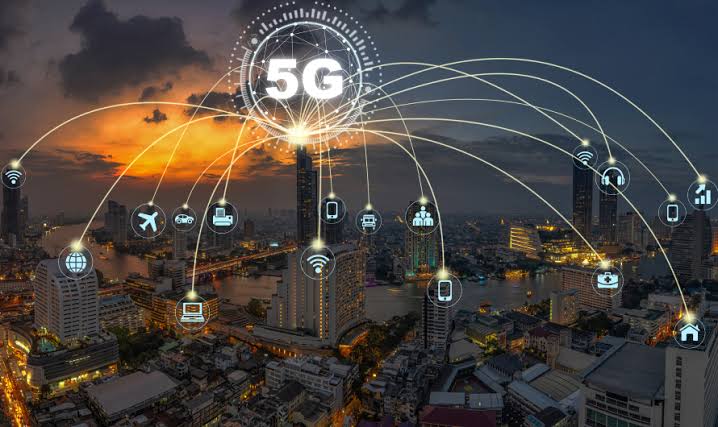
Ghana is racing to expand 5G coverage to 70 per cent of its population by March 2027, as the government accelerates spectrum allocation and infrastructure upgrades ahead of the country’s 70th independence anniversary.
The ambitious target, announced in May 2026 under the banner “70 per cent coverage for Ghana at 70,” is putting pressure on regulators, telecom operators and infrastructure providers to translate policy commitments into functioning high-speed networks across the country.
With the deadline only months away, Ghana is now moving into a critical phase of its 5G rollout after the National Communications Authority (NCA) cleared three companies to compete for spectrum in key frequency bands.
MTN, Telecel and Goal qualify for 5G spectrum
The NCA announced on September 9 that MTN Ghana, Telecel Ghana and Goal Telecommunications had qualified to participate in the next stage of the spectrum selection process.
The companies are competing for frequencies in the 700 MHz, 2.3 GHz and 3 GHz bands, which are expected to play an important role in expanding Ghana’s 5G capacity.
Infrav Ltd, which also applied, was disqualified from the process.
The development follows a major policy change by the NCA. In July, the regulator ended the wholesale 5G exclusivity previously granted to Next Gen Infraco (NGIC), opening the market to additional players.
The regulator said the move was intended to encourage competition, investment and innovation while supporting wider access to advanced mobile broadband services.
Government wants more than the 5G logo
For Ghanaian authorities, the 5G ambition is not simply about increasing the number of smartphones displaying a 5G signal.
Communications Minister Samuel Nartey George has highlighted the need to address the technology gap affecting rural and remote communities, where some telecommunications sites continue to depend on older 2G and 3G infrastructure.
While those networks remain useful for basic voice and messaging services, their limitations become more apparent as more economic and social activities move online.
Mobile money, digital agriculture, online education, telemedicine and other data-intensive services require faster and more reliable connectivity.
The government therefore wants the rollout to involve the upgrading of ageing infrastructure to 4G- and 5G-capable networks, alongside improvements to the fibre and microwave backhaul systems needed to deliver reliable broadband performance.
The minister has effectively framed the programme around the principle that “coverage must translate into meaningful connectivity,” particularly for communities that have historically lagged behind major urban centres.
Ghana’s 5G strategy takes another turn
Ghana’s path to 5G has already undergone several changes.
NGIC, the country’s wholesale 4G/5G network operator, began commercial operations in March 2026, initially providing services in parts of Accra, Kumasi and Tamale.
However, the NCA began reviewing NGIC’s wholesale 5G exclusivity in March before formally ending the arrangement on July 15.
The regulator subsequently opened the door to new spectrum applications, arguing that a more competitive market would provide stronger incentives for investment and innovation.
Four companies submitted applications before the August 27 deadline, setting the stage for the latest qualification process.
With three now cleared, the competition for spectrum is moving forward.
Why the 700 MHz band matters
One of the most important aspects of the spectrum process is the inclusion of the 700 MHz band.
Lower-frequency spectrum can be particularly valuable for expanding coverage because signals can travel farther and penetrate buildings more effectively than higher-frequency bands.
For Ghana, this could be important in extending advanced mobile services beyond dense urban centres.
The 2.3 GHz and 3 GHz bands, meanwhile, can provide additional capacity for high-speed services, particularly in areas experiencing growing data demand.
The combination could therefore help operators balance coverage and network capacity as 5G adoption increases.
Deployment expected before year-end
The three successful applicants are expected to proceed to the next phase of the spectrum allocation process, with the government targeting the commencement of broader 5G deployment before the end of 2026.
That leaves a relatively short window between commercial rollout and the March 2027 deadline.
The challenge will not simply be securing spectrum.
Operators will need to deploy compatible base stations, upgrade existing sites, expand fibre and microwave backhaul, secure reliable power and ensure that networks can support sustained traffic as more users come online.
These infrastructure requirements could determine whether Ghana achieves meaningful nationwide coverage or simply records strong 5G availability in selected urban areas.
Rural Ghana will be the real test
The most important measure of the programme could ultimately be what happens outside Accra and other major cities.
Urban Ghana is likely to benefit first from commercial 5G deployment because operators can serve large concentrations of customers and businesses.
Rural communities, however, often present higher deployment costs and lower immediate commercial returns.
This makes the government’s infrastructure strategy particularly important.
If the 70 per cent coverage target is achieved without sufficiently addressing rural and underserved areas, Ghana could still face a digital divide in which advanced connectivity is concentrated among urban populations.
For citizens, the value of the programme will therefore be measured not by how many locations display a 5G signal, but by whether people can actually access affordable, reliable high-speed services.
What Ghana’s 5G push means for the economy
A successful rollout could strengthen Ghana’s digital economy by improving the infrastructure available to fintech companies, technology startups, businesses, schools, healthcare providers and government services.
Faster networks can also support emerging technologies such as cloud computing, Internet of Things applications, artificial intelligence-enabled services and industrial automation.
But affordability will remain an important part of the equation.
Network availability does not automatically translate into adoption. Consumers still need compatible devices, affordable data and reliable electricity to take advantage of faster networks.
That means Ghana’s 5G strategy will ultimately be judged on three fronts: coverage, affordability and actual usage.
The regulatory groundwork is now being laid, with MTN Ghana, Telecel Ghana and Goal Telecommunications moving forward in the spectrum race.
The bigger question is whether Ghana can convert that progress into widespread, affordable and reliable connectivity before it celebrates 70 years of independence in March 2027.
For a country seeking to deepen its digital economy, the deadline is no longer simply a symbolic target. It is becoming a test of whether policy, spectrum, infrastructure and private-sector investment can move together quickly enough to deliver meaningful digital inclusion.